
The Language Precedes the Policy
Pete Hegseth did not call NATO a “paper tiger” by accident. Language choices at the Secretary of Defense level are institutional signals. The phrase communicates, in two words, a specific strategic assessment: that the alliance is structurally incapable of deterrence, that European member states have not built the capacity to defend themselves, and that continued American underwriting of their security calculus is a subsidy that distorts rather than strengthens collective defense.
The diagnosis is not entirely wrong. Several NATO members have spent years below the alliance’s 2% of GDP defense spending commitment. The gap between declared alliance capability and actual warfighting readiness has been documented in successive NATO assessments. Hegseth is weaponizing a real institutional failure to advance a specific strategic outcome: the reduction of the American military footprint in Europe.
What the Review Actually Threatens
The six-month review of U.S. troop deployments in Europe is not a bureaucratic exercise. It is a coercive instrument. Over 100,000 U.S. military personnel are currently stationed across Europe — a number that expanded significantly following Russia’s 2022 invasion of Ukraine. These troops are distributed across Germany, Poland, Romania, Italy, and the United Kingdom, among other locations. Their presence is not merely symbolic; it represents forward-deployed capability, logistics infrastructure, and — most critically — the physical manifestation of Article 5 credibility.
When a Defense Secretary orders a formal review of those deployments under a six-month timeline, every NATO capital that hosts American forces must now calculate the possibility of their removal. That calculation immediately affects defense procurement decisions, alliance burden-sharing negotiations, and the threat assessments of potential adversaries. Moscow watches a six-month review with institutional interest. So does Beijing, which reads European security instability as bandwidth compression for Washington.
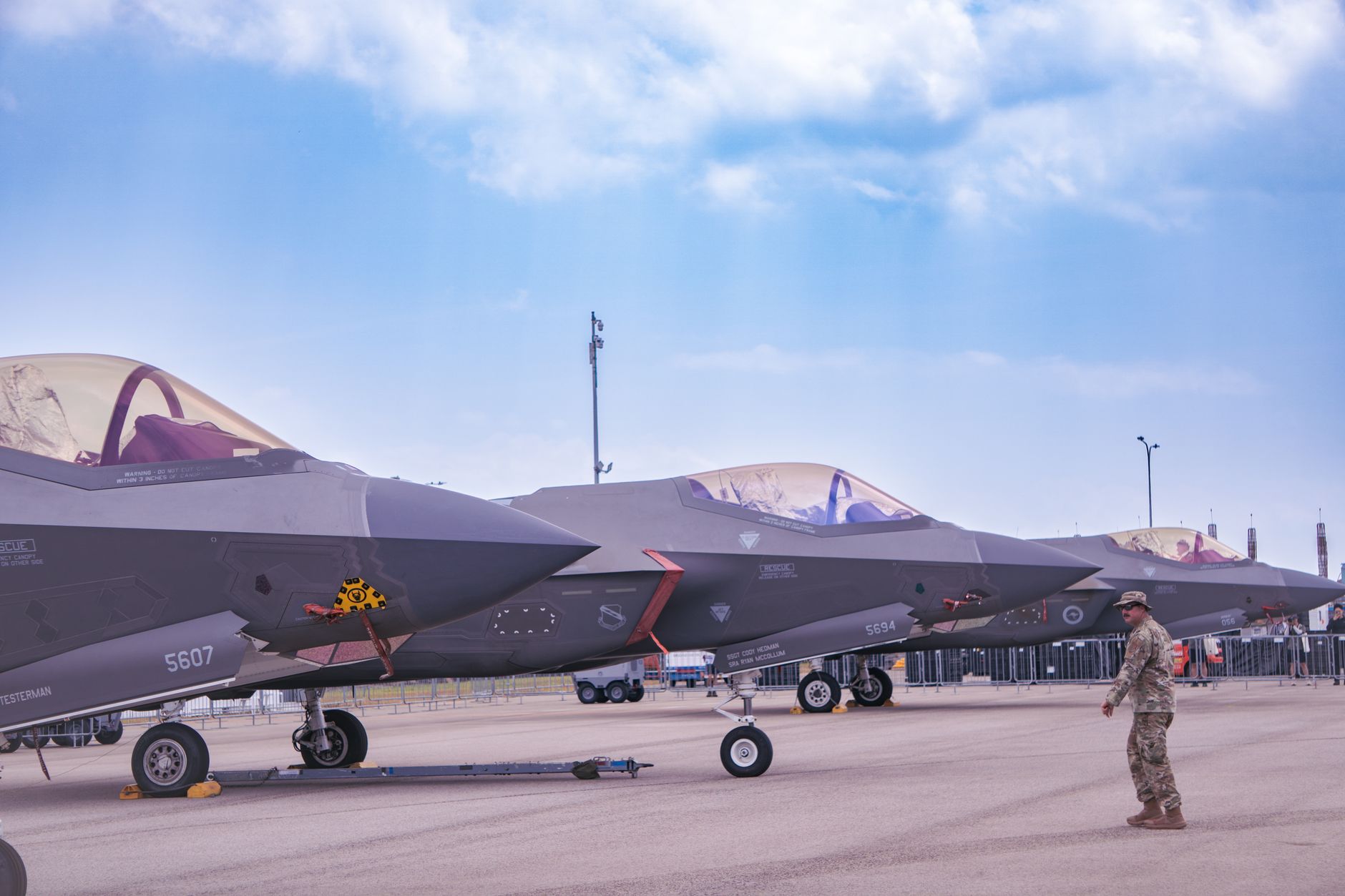
Ramstein Air Base in Germany hosts one of the largest concentrations of U.S. military personnel in Europe and sits directly within the scope of Hegseth's deployment review.
Thang Cao / PexelsThe Spending Gap That Makes the Argument
Hegseth’s political leverage derives from a structural reality: the alliance’s defense spending distribution is deeply uneven. Poland, now spending over 4% of GDP on defense, has made the investment. The Baltic states have dramatically increased their allocations since 2022. But Belgium, Spain, and Italy remain below the 2% threshold by a significant margin. Germany, the alliance’s largest European economy, only crossed the threshold in 2024 — and did so in part through accounting adjustments.
This spending gap is the foundation on which the “paper tiger” argument rests. It allows Washington to frame its pressure campaign not as abandonment but as accountability. The rhetorical structure is effective precisely because the underlying data supports it. European capitals cannot easily rebut the argument because the evidence is their own budget lines.
The political consequence is that Hegseth can simultaneously threaten the alliance’s operational coherence and occupy the moral high ground of fiscal responsibility. That is a structurally advantageous position for the United States to hold in any renegotiation of alliance terms.
NATO Defense Spending as % of GDP (2025 Estimates)
European Strategic Autonomy: Aspiration Meets Timeline
Europe’s response to sustained American pressure has been to accelerate rhetoric around strategic autonomy — the concept that the European Union and its member states should develop independent defense capability not contingent on American political will. The European Defence Fund, the recently announced €800 billion rearmament initiative, and bilateral defense agreements between major European powers all point in this direction.
The problem is time. Building genuine strategic autonomy — integrated command structures, interoperable logistics, independent satellite intelligence, autonomous nuclear deterrence — takes decades, not months. The six-month review Hegseth has ordered operates on a timeline that European rearmament cannot match. If the review concludes with significant troop withdrawals, Europe will face a deterrence gap before its strategic autonomy programs can fill it.
This is the structural trap. The pressure to spend more is legitimate. The timeline imposed by the pressure is not calibrated to the actual speed of institutional military development. Whether that mismatch is a design feature or a byproduct of domestic American politics is a question European defense planners cannot afford to leave open.
What Alliances Actually Require
Alliances are not contracts. They are ongoing political constructions that require continuous maintenance of shared threat perception, mutual institutional investment, and credible signals of reciprocal commitment. NATO has functioned for over seventy years because successive American administrations — regardless of party — treated the maintenance of that construction as a core interest.
The current administration has made a different calculation. It treats the alliance as a transactional arrangement in which American commitment scales with European financial contribution. That framing is not irrational as a negotiating position. It becomes dangerous when it is applied with deadlines, public humiliation, and formal reviews that generate uncertainty about the core commitment itself.
Alliance credibility is not divisible. Once an adversary has reason to believe that Article 5 might not trigger — because the American force presence is under active review, because the Defense Secretary has called the alliance a paper tiger, because a six-month clock is running — deterrence has already partially failed. The review’s damage is not contingent on its conclusions. The damage is the review itself.